|
United States Coast Guard History
The United States Coast Guard (USCG) is a military branch
of the United States involved in maritime law, mariner assistance and search and
rescue, among other duties of any coast guard. One of the seven uniformed
services of the United States, and the smallest armed service of the United
States, its stated mission is to protect the public, the environment, and the
United States economic and security interests in any maritime region in which
those interests may be at risk, including international waters and America's
coasts, ports, and inland waterways.
It has a broad and important role in homeland security, law
enforcement, search and rescue, marine environmental pollution response and the
maintenance of river, intracoastal and offshore aids to navigation (ATON). It
also lays claim to being the United States' oldest continuous seagoing service.
The United States Coast Guard has about 40,150 men and women on active duty.
The Coast Guard's motto is Semper Paratus, meaning "Always
Ready".
The Coast Guard began as the Revenue Cutter Service which
was founded on August 4, 1790 as part of the Department of the Treasury. An act
of the U.S. Congress created the Coast Guard in 1915, with the merger of the
Revenue Cutter Service and the United States Lifesaving Service. The United
States Lighthouse Service was merged into the Coast Guard in 1939. The legal
basis for the Coast Guard is Title 14 of the United States Code, which states:
"The Coast Guard as established January 28, 1915, shall be a military service
and a branch of the armed forces of the United States at all times." Upon the
declaration of war or when the President directs, the Coast Guard operates under
the authority of the Department of the Navy. The Coast Guard later moved to the
Department of Transportation in 1967, and on February 25, 2003 it became part of
the Department of Homeland Security.
Organization
The headquarters of the Coast Guard is on 2100 Second
Street, SW, in Washington, DC. In 2005, the Coast Guard announced plans to
relocate to the grounds of the former St. Elizabeth's Hospital in Washington.
Senior officers
Admirals
The Commandant of the Coast Guard is the Coast Guard's
senior officer, who, by law, holds the rank of Admiral. The Commandant is
selected for a 4-year term, which may be renewed for additional 4-year periods.
The current incumbent is Admiral Thomas H. Collins, who assumed command on May
30, 2002. On January 20, 2006, President Bush announced he intends to nominate
Vice Admiral Thad Allen to serve as the next Commandant of the Coast Guard.
Admiral Allen will receive his fourth star and promotion to Admiral when he
assumes the position of Commandant.
Vice Admirals
The Vice Commandant of the Coast Guard is Vice Admiral
Terry Cross.
The Chief of Staff of the Coast Guard is Vice Admiral Thad
W. Allen. He also serves as Commanding Officer of Coast Guard Headquarters.
After Hurricane Katrina struck the Gulf states in September 2005, Admiral Allen
was sent to coordinate rescue and relief operations under Federal Emergency
Management Administrator Michael Brown. Mr. Brown was relieved of day-to-day
operations on September 9 and Admiral Allen was placed in charge of the overall
effort. Admiral Allen was relieved of this position on January 27, 2006 and has
resumed his duties as Chief of Staff until he is appointed to the position of
Commandant.
The Commander of the Atlantic Area and Maritime Defense
Zone Atlantic is Vice Admiral Vivien S. Crea, who assumed the command in July
2005. The Commander of the Pacific Area and Coast Guard Defense Forces West is
Vice Admiral Harvey E. Johnson, Jr..
In early April 2006, VADM Harvey Johnson, Jr. was nominated
by President Bush to become the Deputy Director of FEMA, following his
retirement from the Coast Guard.
Rear Admirals
The Superintendent of the United States Coast Guard Academy
is Rear Admiral (upper half) (RADM) James C. Van Sice. The Director of Reserve
and Training is RADM Sally Brice-O'Hara. In addition, each District is commanded
by a Rear Admiral.
Commodores
The rank of Commodore is no longer used in the regular
Coast Guard. The equivalent rank is Rear Admiral, Lower Half. The chief elected
officers of the Coast Guard Auxiliary are called Commodores. This is not a
military rank, however.
The title of Commodore is occasionally granted to senior
officers (typically of of pay grade 0-6, which is a Captain) who is placed in
command of a group or squadron of cutters. It is not a flag rank, but rather a
title used to signify command of multiple units afloat.
Captains
Coast Guard Captains, like their Navy counterparts, rank
immediately below Rear Admiral (lower half). Coast Guard Captains command most
large operational units -- sectors, large cutters, large air stations,
integrated support commands, training centers and large headquarters units.
Captains also direct most headquarters, area and district staff elements. Most
captains have served in the Coast Guard for 21 to 30 years.
By maritime tradition, the commanding officer of a ship is
also called "captain" regardless of actual rank held. Thus, a young Lieutenant
commanding a patrol boat is properly called "captain" even if his or her actual
rank is Lieutenant, or Lieutenant (Junior Grade). This tradition has also
carried over to many shore units. Occasionally, terms like "old man" and
"skipper" are also used, though not usually in the presence of the "captain."
However, in current usage, the person in charge of a Coast Guard or Coast Guard
Auxiliary boat is the "coxswain" (pronounced cok-sun).
Chief Petty Officers
The Master Chief Petty Officer of the Coast Guard (MCPOCG)
is the senior enlisted person of the Coast Guard and serves as an advisor to the
Commandant. Like the Commandant, the MCPOCG serves a four-year term. The current
MCPOCG is Frank A. Welch, who assumed this position in 2002; his term expires in
2006, and his replacement is being sought. The Master Chief of the Coast Guard
Reserve is MCPO Jeff Smith.
Chief Petty Officers, often called "the Chief", are one of
the leadership backbones of the Coast Guard. Chiefs are well versed on most
anything, and the old addage of "go ask the Chief" holds true today. Chiefs are
Officers-in-Charge of Motor Lifeboat Stations, act as Executive Petty Officers
on Patrol Boats, and keep larger Coast Guard cutters on a true head bearing as
Deck Watch Officers.
Regional responsibilities
The Coast Guard is divided into two Areas, the Atlantic and
the Pacific, each of which is commanded by a vice admiral, with each being
designated Maritime Defense Zones.
The Coast Guard is then organized into districts, each
responsible for a portion of the nation's coastline.
U.S. Coast Guard Districts District Region District Office
Area of Responsibility
First District Atlantic Boston, Massachusetts New England
states, New York, and northern New Jersey
Fifth District Atlantic Portsmouth, Virginia Pennsylvania,
southern New Jersey, Delaware, Maryland, Virginia, and North Carolina
Seventh District Atlantic Miami, Florida South Carolina,
Georgia, eastern Florida, Puerto Rico, and the U.S. Virgin Islands
Eighth District Atlantic New Orleans, Louisiana Inland
waters of the U.S. and the Gulf of Mexico
Ninth District Atlantic Cleveland, Ohio Great Lakes
Eleventh District Pacific Alameda, California California,
Arizona, Nevada, and Utah
Thirteenth District Pacific Seattle, Washington Oregon,
Washington, Idaho and Montana
Fourteenth District Pacific Honolulu, Hawaii Hawaii and
Pacific territories
Seventeenth District Pacific Juneau, Alaska Alaska
In each district, large operational centers known as Groups
are being merged with Marine Safety Offices and being re-designated Sectors.
Smaller boat stations are Stations, while aircraft fly from Coast Guard Air
Stations. Stations report to Sectors, while Sectors and Coast Guard Air Stations
report to District offices.
An example of this is Sector Baltimore, which is located at
Curtis Bay, Maryland. Sector Baltimore is responsible for the waters from the
C&O Canal north of Baltimore to the south shore of the Potomac River. In this
sector there are several stations, including Coast Guard Station Annapolis,
located near the United States Naval Academy, Coast Guard Station Washington,
D.C., located on Bolling Air Force Base in Washington, D.C., Coast Guard Station
St. Inigoes, Maryland, and Coast Guard Station Quantico, Virginia, among others.
Sector Baltimore also has the Baltimore Marine Safety Office. To the south of
Sector Baltimore is Sector Hampton Roads, Virginia; to the north is Sector
Delaware Bay. Sector Baltimore has no air station under its operational control,
but helicopters from Coast Guard Air Station Atlantic City and Auxiliary
aircraft overfly the area on patrol.
Coast Guard Air Stations
The first Coast Guard Air Station was established in 1920
at Morehead City, North Carolina. Another Air Station was established in Biloxi,
Mississippi between 1933 and 1947, and yet a third at Floyd Bennett Field in
Brooklyn, New York.
First District
CGAS Cape Cod, Massachusetts
Fifth District
CGAS Atlantic City, New Jersey
CGAS Elizabeth City, North Carolina: This is both an
operational and a training air station. Enlisted Coast Guardsmen in aviation
ratings are taught at its Aviation Technical Training Center.
Seventh District
CGAS Clearwater, Florida
CGAS Miami, Florida
CGAS Savannah, Georgia
CGAS Borinquen, Puerto Rico
Eighth District
CGAS Houston, Texas
CGAS Corpus Christi, Texas
CGAS New Orleans, Louisiana
Coast Guard Aviation Training Center, Mobile, Alabama: This
is both an operational and a training air station. Besides performing
operational missions, Coast Guard Aviators (pilots) receive flight training on
the HH-65, HH-60, and HU-25 aircraft.
Ninth District
CGAS Detroit, Michigan
CGAS Traverse City, Michigan
Eleventh District
CGAS Humboldt Bay, California
CGAS Sacramento, California
CGAS San Francisco, California
CGAS Los Angeles, California
CGAS San Diego, California
Thirteenth District
CGAS Astoria, Oregon
CGAS North Bend, Oregon
CGAS Port Angeles, Washington
Fourteenth District
CGAS Barbers Point, Hawaii
Seventeenth District
CGAS Kodiak, Alaska
CGAS Sitka, Alaska
Personnel
Officer Corps
Commissioned officers join the Coast Guard by several
means:
U.S. Coast Guard Academy
The United States Coast Guard Academy is located on the
Thames River in New London, Connecticut. It is the only military academy, apart
from the specialized Uniformed Services University of the Health Sciences, to
which no Congressional or Presidential appointments are made. All cadets enter
by open competition utilizing SAT scores, high school grades, activities, etc.
About 175 cadets are commissioned ensigns each year. Graduates of the Academy
must serve 5 years' active duty.
Officer Candidate School
In addition to the Coast Guard Academy, officers may enter
the Coast Guard through a 17-week Officer Candidate School (OCS) at the Coast
Guard Academy in New London, Connecticut. Graduates of OCS must serve 3 years'
active duty. OCS is a rigorous seventeen-week course of instruction which
prepares candidates to serve effectively as officers in the United States Coast
Guard. In addition to indoctrinating students into a military life-style, OCS
also provides a wide range of highly technical information necessary for
performing the duties of a Coast Guard officer.
Graduates of the program receive a commission in the Coast
Guard at the rank of Ensign and are required to serve a minimum of three years
of active duty. Graduates may be assigned to a ship, flight training, to a staff
job, or to an operations ashore billet. However, first assignments are based on
the needs of the US Coast Guard. Personal desires and performance at OCS are
considered. All graduates must be available for world wide assignment.
Chief Warrant Officer
Highly qualified enlisted personnel from E-6 through E-9
compete every year for appointment as a Chief Warrant Officer. Successful
candidates are chosen by a board and then commissioned as Chief Warrant Officers
(W-2).
In addition to United States citizens, foreign cadets and
candidates also attend Coast Guard officer training.
Enlisted
Newly enlisted personnel are sent to eight weeks of Basic
Training at Coast Guard Training Center Cape May in Cape May, NJ. The training
schedule includes:
Physical fitness
Water survival and swimming qualifications
Wellness and nutrition
Self discipline
Military skills
Military bearing
Following graduation, most members are sent to their first
unit while they await orders to attend advanced training, in Class "A" Schools,
in their chosen rating, the naval term for military occupational specialty
(MOS). Some members go directly to "A" School upon graduation from Basic
training.
Petty officers follow career development paths similar to
those of the Navy.
Enlisted Coast Guard members who have reached the pay grade
of E-7, or Chief Petty Officer, must attend the U.S. Coast Guard Chief Petty
Officer Academy at Petaluma, California, or an equivalent Department of Defense
school, to be promoted to pay grade E-8. United States Air Force master
sergeants, as well as international students representing their respective
maritime services, are also eligible to attend the CPO Academy. The basic themes
of this school are:
Professionalism
Leadership
Communications
Systems Thinking and Lifelong Learning
Equipment
The U.S. Coast Guard uses cutters and small boats on the
water, and fixed- and rotary wing (helicopters) aircraft in the air.
Cutters
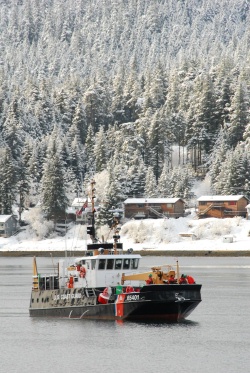
A cutter is any Coast Guard vessel, with a permanently
assigned crew and accommodations for the extended support of that crew. See
chapter 10 USCG Regulations (Cutters are traditionally 65 ft. or greater in
length). Larger cutters (over 180 feet (55 m) in length) are controlled by Area
Commands (Atlantic Area or Pacific Area). Smaller cutters come under control of
District Commands. Cutters usually carry a motor surf boat and/or a rigid-hulled
inflatable boat. Polar-class icebreakers (WAGB) carry an Arctic Survey Boat (ASB)
and Landing Craft. The CGC Ahi is the last 87-foot cutter to be added to the
Coast Guard fleet.
Currently, the Coast Guard is leasing five PC-179 coastal
patrol ships from the U.S. Navy; two (including CGC Monsoon operate from San
Diego) and three from Pascagoula, Mississippi. These vessels are used primarily
for counterdrug patrols. (PA3 Brian Leshak, "CG Leases Navy Ships, Fights Drug
War." Coast Guard Magazine 2/2006, pp. 32-33).
The Guard owns about 210 aircraft. Fixed-wing aircraft,
such as (HC-130 Hercules turboprops and HU-25 Guardian jets) operate from Air
Stations on long-duration missions. Helicopters (HH-65 Dolphin, HH-60 Jayhawk,
and MH-68 Stingray) operate from Air Stations, Air Facilities, and flight-deck
equipped Cutters, and can rescue people or intercept smuggling vessels.
The Coast Guard flies five aircraft types:
HC-130 Hercules
HU-25 Falcon / Guardian [1]
HH-60 Jayhawk [2]
HH-65 Dolphin
MH-68 Stingray U.S. Coast Guard HITRON: [3]
The Coast Guard is planning to purchase 36 CASA CN-235 from
Spanish aircraft manufacturer Construcciones Aeronáuticas SA (CASA) for medium
range search. As of February 2, 2006, the first of the aircraft are under
construction for delivery in early 2007
In addition to regular Coast Guard aircraft,
privately-owned general aviation aircraft are used by Coast Guard Auxiliarists
for patrols and search-and-rescue missions.
Boats
USCG motor life boat escorting the Spirit of Ontario I
Fast Ferry into the port of Rochester, New York on 2004-08-08
A Coast Guard 25-foot Defender- class boat from Station
Seattle enforces a security zone around a Washington State Ferry in Elliot Bay
Dec. 22, 2003.
The Coast Guard operates about 1,400 boats, defined as any
vessel not designated as a Cutter (traditionally less than 65 ft. (20 meters) in
length), which generally operate near shore and on inland waterways. The most
common is 41 feet (12.5 meters) long, of which the Guard has more than 200; the
shortest is 12 feet (4 meters).
Arctic Survey Boat (ASB)
Motor Life Boat (MLB)
Utility Boat (UTB)
Deployable Pursuit Boat (DPB)
Aids to Navigation Boats (TANB/BUSL/ANB/ANB)
Transportable Port Security Boat (TPSB): 25-foot boat,
based on the commercial version of the 25' center-console Boston Whaler,
suitable for work in inland waters, easily transportable by trailer. These are
primarily used by Port Security Units for force protection in naval support
areas abroad, as well as, ports of embarkation/debarkation in expeditionary
areas. Most recently these boats and units were deployed to Kuwait in support of
Operation Iraqi Freedom. The durability, versatility, and mobility of these
boats make them ideal for this type of operation.
Rigid Hull Inflatable Boat (RHI) Rigid inflatable boats are
deep-V glass-reinforced plastic hulls wrapped in a multi-compartment buoyancy
tube. They are powered by a gasoline outboard motor or an inboard/outboard
diesel engine. The RHI can be easily deployed from a cutter with a four-point
bridle for davit lifting and lowering. The RHI's portability and ruggedness
allow it to be used on many kinds of missions.
USCG Short Range Prosecutor (SRP): 7-metre launch that can
be launched from a rear launching ramp, at speed
USCG Long Range Interceptor (LRI): 11-metre high-speed
launch that can be launched from the rear ramps of the larger Deepwater cutters.
The Coast Guard recently introduced a standard
search-and-rescue (SAR) and response boat, the is 25-foot Defender-class boat,
to replace nonstandard boats and platforms at Coast Guard stations. The Defender
class can go faster than 40 knots (75 km/h), cruise at 35 knots, mount an M-60
or M-240 machine gun in the bow, and be transported by a C-130 Hercules aircraft
(or, more prosaically, a boat trailer.) The Defender class has twin Honda
outboard motors and has a range of 105 or 125 nautical miles, depending on the
type of fuel tanks used. It can launch with a 2-person crew, but has a carrying
capacity for 10 persons. It has less than 1 meter (3 feet) draft.
Small Arms
Since 1986, Coast Guardsmen on patrol have been armed with
Beretta 9 mm pistol. The Coast Guard is transitioning to the .40 caliber
SigSauer P229R DAK). As of April 2006, this transition was officially complete.
|