|
Captain John A. Kolman, Los Angeles County Sheriff’s Department (ret.), is the founder and first director
of the National Tactical Officer’s Association. John A. Kolman is
the author of The Trials And Tribulations Of
Becoming A Swat Commander, Patrol Response to Contemporary Problems: Enhancing
Performance of First Responders Through Knowledge And Experience and Guide to the Development of Special Weapons and Tactics
Teams.
According to Commander Sid Heal, The
Trials And Tribulations Of Becoming A Swat Commander, “is clearly modeled after "Duffer's Drift" and fills a
gap in those texts that deal with essential material and the more interesting fiction by combining an interesting scenario
with an abundance of lessons learned. Consequently, it should be considered a "must read" for law enforcement SWAT personnel,
but especially entry-level and first-line supervisors. The lessons are durable, reliable and relevant for all domestic law
enforcement but are focused on that critical first-line supervisor. Especially poignant is the overall theme that doing nothing
to prepare yourself to handle these types of situations is a recipe for disaster.”
In 1969, Charles “Sid” Heal joined the United States Marine Corps.
After serving a combat tour in Vietnam, he returned home, joined the Marine Corps reserve and attended college. Commander
Charles “Sid” Heal began his law enforcement career in 1975 as an investigator for the Los Angeles County District
Attorney’s Office. In 1977, he joined the Los Angeles County Sheriff’s
Department as a deputy sheriff. During his law enforcement career, he has worked various assignments within the Los Angeles
County Sheriff’s Department, including Men’s Central Jail, Firestone Station and Industry Station.
Upon being promoted to Sergeant in 1983, Commander Heal worked at Crescenta Valley Station and the Special Enforcement
Bureau. After being promoted to Lieutenant in 1989, Commander Heal worked Central Property and Evidence, Firestone Station,
Lennox Station, Hall of Justice Jail, Transit Services Bureau, Walnut Station, Emergency Operations Bureau, Special Projects
Unit, and Field Operations Region III Headquarters. In January 2000, he was promoted to Captain and selected to command the
Special Enforcement Bureau.
During his 35 years in the Marine Corps he has served in over 20 countries including military operations in
Vietnam, Desert Storm, Somalia and Iraqi Freedom. Charles “Sid” Heal
retired from the United States Marine Corps at the rank of Chief Warrant Officer (CWO5).
Commander Heal holds an Associate of Science Degree in Criminal Justice from Pasadena City College, a Bachelor
of Science Degree in Police Science and Administration from California State University, Los Angeles, a Master’s Degree
in Public Administration from the University of Southern California, and a Master’s Degree in Management from California
Polytechnic University, Pomona. He is also a graduate of the Federal Bureau of Investigation’s National Academy. Commander Charles “Sid” Heal is the author of Sound Doctrine: A Tactical Primer and An Illustrated Guide to Tactical Diagramming.
According to the book description of Sound Doctrine: A Tactical Primer, “In recent years, law enforcement has suffered a number of tactical
fiascoes. Besides the loss of life and deterioration in public confidence, officers
and agencies have been the subject of both civil and criminal actions. Unlike
most tactical books, which reach tactics as a “skill set,” this book emphasizes an intuitive application of fundamental
principles. These principles have evolved over the centuries of tactical operations
and form a body of sound doctrine.” Colonel John B. Alexander, Ph.D. the
author of Future War commented on Sound Doctrine:
A Tactical Primer, “Required reading for all law enforcement supervisors as well as those aspiring to enter
their ranks.” Steve Ijames, Major, Springfield Missouri Police Department,
remarked, “A must read for SWAT team members and commanders alike. It will cause many to rethink their operational processes.”
According to the book description of An Illustrated Guide to Tactical Diagramming, “This book is not about construction, although you will
learn about building codes and practices. It is not about tactics, although the information gained by knowing a floor plan
will undoubtedly affect them. Instead, this book is designed to provide a quick and simple method of confidently determining
floor plans by using outside architectural features. It assumes no knowledge of construction or tactics and is designed to
be useful whether it is read cover to cover or occasionally referred to as a reference. It provides time-tested, tried and
true principles that any tactician can use to determine avenues of approach, observation and fields of fire, obstacles, and
cover or concealment, not to mention where a suspect might be most vulnerable. Using this essential tool for quick and clear
comprehension of tactical diagramming, even a novice tactical planner will learn to use windows, doors, vents and other clues
to confidently determine interior features. After reading this book, it will be clear that the proverbial “glass house”
is in the mind’s eye!”
With
40 years of practice, and almost 25 years as a police officer James L. Greenstone, Ed.D., has expertise as a police psychologist,
a therapist, a teacher, an author, a police officer, a mediator and negotiator, and as a consultant. The field of Crisis Intervention
has been his focus. For the better part of his career as a police officer, he
has worked extensively in the field of hostage and crisis negotiations. As a mental health professional and consultant, and
as a trainer of negotiators, as well as a member of hostage negotiations teams, he is knowledgeable about negotiator training,
current practices in this area, dealing with suicidal and barricaded subjects, negotiations techniques, team development,
and team and negotiator interactions with police tactical units. He has participated in numerous hostage, barricaded and suicidal
situations, and has practical experience in all aspects of hostage and crisis negotiations team functioning.
Dr.
James L. Greenstone’s book, The Elements
of Police Hostage and Crisis Negotiations, “is designed for day-to-day, on-the-scene use. It is a practical
handbook for experienced professionals and novices that can also be used as a supplementary textbook for criminal justice,
crisis intervention, and psychology coursework. Each chapter contains useful checklists, procedural notes, tables, strategy
worksheets, and forms, and the book includes special indices for quick reference in addition to a traditional index. The book
examines the negotiation process from start to finish, including pre-incident preparations, first response responsibilities,
responding to the call-out, arriving at the scene, preparing to negotiate, making contact, preparing for the surrender, post-incident
tasks, preparing equipment, and more.”
Ronald M. McCarthy served as a Los Angeles police officer for over twenty-four. He was assigned to the department's
tactical unit, Metro Division, for 20 years and retired from Special Weapons and Tactics as the senior supervisor and assistant
commander in 1984. Ronald McCarthy was the chief of Tactical Operations for the U.S. Department of Energy from 1984 through
1986. He was the director of the Deadly Force Training Grants for the U.S. Department of Justice and the International Association
of Chiefs of Police (IACP) from 1986 through 1988. Ronald McCarthy served as manager for IACP's Center for Advanced Police
Studies from 1985 through 1992.
Since 1992, Ronald McCarthy has been the owner of R.M. McCarthy & Associates, a training, consulting, and
marketing resource for law enforcement. He has trained police officers from Europe, South America, the Middle East, and more
than 30,000 police officers and military here in the United States.
Ronald McCarthy was awarded the Los Angeles Police Department Medal of Valor for action against the Symbionese
Liberation Army in 1975, and the Police Star for the rescue of hostages in 1983. He was presented with the National Tactical
Officers Association Award for Excellence in 1990. In 1995 the City of Erie, Pa., presented him with the All American Hero
Award for his service to law enforcement throughout the United States. In October of 1996, Ronald McCarthy was awarded the
National Tactical Officers Association's Lifetime Achievement Award.
Ronald McCarthy is the co-author of The
Management of Police Specialized Tactical Units. According to the book
description, “Managerial responsibility of a SWAT team requires continuous research in the material area of long-term
criminal trends as well as keeping abreast of new developments in relevant tactics, technology, and techniques of law enforcement
and the legal issues covering their use. The Management of Police Specialized Tactical Units explains the steps for developing
and maintaining a realistic, effective response to increasing levels of violent crime. The book makes extensive use of actual
field examples such as the North Hollywood Bank of America Shootout, the Mogadishu Airport Incident, the Springle Street Incident,
and the confrontation between police and the Symbionese Liberation Army. Chapter Six discusses the various types and sources
of equipment designed to give tactical units more effective technological choices and includes examples of practical application,
and the advantages and disadvantages of use. It answers questions of law regarding when and under what circumstances the equipment
may be used. Chapter Ten focuses on the partnership needed between law enforcement and the media. The importance of cooperation
is stressed to ensure safety of police officers, hostages, news personnel, and bystanders during a hostage situation. Suggestions
for establishing trust and credibility are presented. The final chapter explores tactical operations of the future when dealing
with increasingly violent encounters with juvenile offenders, the phenomenon of “suicide-by-cop,” and the likelihood
of terrorist use of weapons of mass destruction.”
Vincent
Faggiano retired from the Rochester Police Department at the rank of captain. He was responsible for the initial development
of the BowMac Critical Incident Response training programs, both for first responders and executive command post managers.
He has delivered these programs to thousands of law enforcement officers, firefighters, emergency medical technicians, and
elected officials in the United States and abroad. He is the co-author of Critical Incident Management. According to the book description, Critical Incident Management, “shows you how to respond effectively to any incident. The book focuses
on first responders and initial actions, the areas typically overlooked by police agencies and the ones most criticized after
the fact.”
SWAT Operational Guidelines and Standardized Training Recommendations - Published by California POST
- You can Download a copy here: http://www.post.ca.gov/training/swatmanual/swatmanual.pdf
TABLE OF CONTENTS Definition of SWAT SWAT Team Components Policy Considerations Risk
Assessment Planning Logistical and Resource Needs Legal and Practical issues of SWAT Operations Uniforms, Equipment,
and Firearms Personnel Selection, Physical Fitness and Core Skills Proficiency SWAT Training Multi-Jurisdictional
SWAT Operations After-Action Evaluation Specialized Functions and Supporting Resources A Basic SWAT
Team Operational Components Basic SWAT Course Topics SWAT Core Competencies SWAT/Tactical Commanders’ Course
Topics Core Competencies for SWAT K-9 Teams Basic Crisis Negotiator Course Recommended Course Topics Crisis Negotiations
Core Competencies Long Rifle/Observer Team Course Topic Recommendations Tactical Waterborne Core Competencies
| Military Guide to Terrorism |

|
| Click the image to download the guide |

The Central Intelligence Agency's (CIA) primer on chemical, biological, nuclear and radiological (CBRN) terrorist weapons
is a must have guide.

Every SWAT Commander and SWAT officer can use a copy of the United States Marine Corps' Individual Guide to Terrorism Download
your copy now
SWAT
SWAT
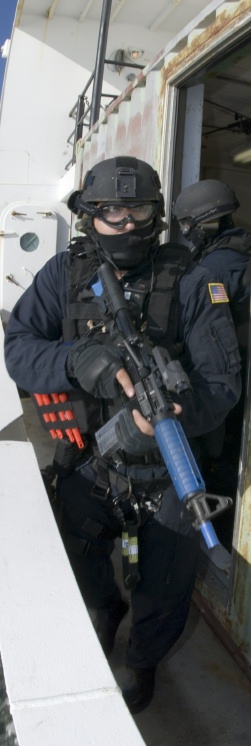
SWAT (an acronym for Special Weapons And Tactics; originally Special
Weapons Assault Team) is a specialized paramilitary police unit in major
United States city police departments, which is trained to perform dangerous
operations. These can include coordinated attacks on selected targets such as
heavily armed criminals in secure locations. SWAT teams are equipped with
specialized firearms including submachine guns, carbines, specialized tear
gas, concussion grenades, and high-powered rifles for marksmen (snipers). They
often have specialized equipment including heavy body armor, entry tools,
steel reinforced boots and night vision optics.
History
The first SWAT unit was created in the city of Delano, California, in the
1960s in response to the farmworker uprisings led by the then-new UFW headed
by César Chávez. This unit was a department-wide team which received
specialized crowd control, sniper/counter-sniper, and counter-force training.
In the 1960s, Los Angeles was experiencing problems with sniping incidents
against police officers and civilians. Ordinary police officers handled those
situations poorly, since they received limited weapons training, very little
weapons practice, and effectively no training in team combat tactics or
"counterforce" capability. Classic "riot police" (crowd control) squads did
not fare well either. Officer John Nelson came up with the idea to form a
specially trained and equipped unit, intended to respond to and manage
critical situations while minimizing police casualties. Inspector Darryl F.
Gates approved this idea, and he formed a small select group of volunteer
officers. After seeing the Delano Police Department in action on the news
broadcasts, Los Angeles Police Department officers attended their training,
then expanded on the concept.
This first SWAT unit was initially constituted with fifteen teams of four men
each, for a total staff of sixty. These officers were given special status and
benefits. They were required to attend special monthly training. This unit
also served as a security unit for police facilities during civil unrest. The
LAPD SWAT units were organized as "D Platoon" in the Metro division.
The first significant deployment of LAPD's SWAT unit was on 9 December 1969,
in a four-hour confrontation with members of the Black Panthers. The Panthers
finally surrendered, with only three Panthers and three officers being
injured. By 1974, there was a general acceptance of SWAT as a resource for the
city and county of Los Angeles.
On the afternoon of 17 May 1974, elements of a group which called itself the "Symbionese
Liberation Army" (SLA), a group of heavily-armed leftists, barricaded
themselves in a residence on East 54th Street at Compton Avenue. Coverage of
the siege was broadcast to millions via television and radio and featured in
the world press for days after. Negotiations were opened with the barricaded
suspects on 26 separate occasions, 18 prior to the introduction of tear gas,
and 10 during the ensuing confrontation. Police units did not fire until the
SLA had fired several volleys of semi-automatic and fully automatic gunfire at
them. In spite of the 3,772 rounds fired by the SLA, no uninvolved citizens or
police officers sustained injury from gunfire.
During the gun battle, a fire erupted inside the residence. The cause of the
fire is officially unknown, although police sources speculated that an errant
round ignited one of the suspect's molotov cocktails. Others suspect that the
repeated use of tear gas grenades, which function by burning chemicals at high
temperatures, started the structure fire. All six of the suspects suffered
multiple gunshot wounds and perished in the ensuing blaze.
During the 1984 Summer Olympics, the LAPD SWAT team provided security, often
undergoing grueling hours. Another famous incident was the North Hollywood
shootout, which took place on 28 February 1997.
Since its inception, LAPD SWAT Team members have effected the safe rescue of
numerous hostages, arrested scores of violent suspects and earned hundreds of
commendations and citations, including several Medals of Valor, the
Department's highest award for heroism in the line of duty. The LAPD SWAT
Team, on average, handles ninety barricaded suspect incidents and serves fifty
high-risk warrants a year.
Training
SWAT applicants undergo rigorous selection and training, similar to the
training some special operations units in the military receive. Emphasis is
placed on physical fitness so an officer will be able to withstand the rigors
of close quarters battle. Additionally, officers are trained in marksmanship
for the development of accurate shooting skills. Other training that could be
given to potential officers includes training in
explosives, sniper training,
first-aid, negotiation, handling
K9 units, and other areas. Of primary
importance is close quarters combat training, however, as this will be their
primary mission after becoming a full-fledged SWAT officer.
Tactics
Before deploying, a SWAT team will review the situation at hand. The
officers will be briefed on the mission: the kind of mission (such as serving
a warrant, arresting a suspect, hostage rescue, or others), the physical
layout of the target (the architecture of any buildings involved, for
example), any available intelligence on the target, and the actual tactical
plan to be used.
In a typical arrest mission, the SWAT team will attempt to move in unnoticed,
if possible, to prevent the suspect from fleeing. Once on-site and in place,
the team will attempt to resolve the situation as quickly as possible.
SWAT is very much reserved in terms of hostage rescue/barricaded suspect
situations. The idea behind a SWAT mission is to leave with the least amount
of casualties as is possible. This involves incapacitating or restraining
suspects rather than using lethal force at any opportunity. Although SWAT is
equipped to use force, they generally keep casualties to a minimum, when
possible to bring suspects into custody.
In the typical SWAT call-up situation, stealth entry and movement techniques
are used to conceal the presence of the SWAT officers. Stealth movement is
used when an area is small enough to move through quickly but silently, or
when there is no immediate threat to officer or hostage safety. However, when
obstacles or building size prevent effective stealth entries, a team may force
its way into an area using dynamic entry tactics if needed. The team would
move in to arrest the suspect rapidly and quickly, without any more violence
than is needed. Oftentimes, the strike is so quick that the suspect is
incapable of resisting in a significant manner.
Other missions require different tactics. In hostage rescue situations, the
team will form a perimeter around the area, and call in negotiators to attempt
a peaceful resolution. If the use of force is deemed necessary, then the SWAT
team will attack to neutralize any threats to the hostages. Again, dynamic
entry tactics are used to gain quick entrance to any building involved in the
situation. Non-lethal flash-bangs could be employed in such dynamic entrances
to temporarily stun or incapacitate any suspects (but leave the hostages
unharmed), providing a window of opportunity to strike.
SWAT equipment
SWAT teams use specially-manufactured equipment designed for close-quarters
combat (CQB) in an urban environment. The particular pieces of equipment vary
from unit to unit, but there are some consistent trends in what they wear and
use.
Individual clothing and equipment usually consists of fire-proof Nomex
coveralls, a body armor vest, an outer tactical vest for carrying ammunition
and other gear, Nomex gloves, balaclava, protective eye goggles, Kevlar helmet
or gas mask, flashlight, soft-soled urban boots, flexi-cuffs, and thigh ammo
pouches. While a wide variety of weapons are used by SWAT teams, the usual
weapons include submachine guns, carbines, assault rifles, shotguns, sniper
rifles, flashbang (concussion) and tear gas grenades, and semi-automatic
handguns. Popular submachine guns used by SWAT teams include the 9mm Heckler &
Koch MP5 and 10mm MP5/10, with or without suppressors. Common rifles include
the M16 and M4 Carbine. In departments that have a higher budget, newer guns
such as the Heckler & Koch G36 are being issued. Firing a standard 5.56 mm
rifle round, and a collapsible stock, it possesses both high stopping power as
well as a small footprint. To breach doors quickly, battering rams, shotguns,
or explosive charges can be used to break the lock or hinges, or even demolish
the door frame itself.
SWAT units may also employ armored cars for insertion, maneuvering, or during
the actual assault. Helicopters may be used to provide aerial reconnaissance
or even insertion via rappelling. To avoid detection during insertion in urban
environments, SWAT units may also use modified buses or other seemingly normal
vehicles. Such vehicles are usually only found in larger cities that can
afford and justify their purchases.
For tactical reconnaissance purposes, a team may be equipped with binoculars,
fiber optic cameras, thermal cameras, mirror rigs, or a variety of audio or
video surveillance equipment. In nighttime operations, SWAT units may be
equipped with night vision goggles.
Cultural references
This kind of police unit quickly became well known with the premiere of the
short-lived but notorious television series S.W.A.T. in the 1970s, which was
panned as being overly violent and unrealistic with the characters regularly
undergoing missions that usually happen only once in a lifetime for actual
teams.
There is a series of computer games by Sierra Entertainment and developed by
Vivendi Universal and Irrational Games under the name of SWAT, in which the
player commands a SWAT team and utilizes real tactics and tools used in
situations. The series started off as an interactive movie followup of the
Police Quest series which was narrated by retired Chief Daryl Gates, and was
continued as a real-time strategy then two first person shooters in the vein
of Rainbow Six. All but one featured endorsements by the LAPD.
During the 1990s, there was also a cartoon TV show called SWAT Kats.
In 2003, the movie S.W.A.T. starring Samuel L. Jackson and Colin Farrell was
released in theaters. In the movie, an arrested drug kingpin is transported by
a Los Angeles Police Department SWAT team led by Jackson's character out of
the city and into federal custody. Plans go awry when the kingpin offers $100
million to anyone who can free him.
Both Power Rangers: SPD and Tokusou Sentai Dekaranger, police based superhero
teams, feature a SWAT mode, consisting of a set of armor and heavy weapons, as
well as a laser-armed SWAT truck (only Power Rangers) and a SWAT Megazord
(only named so in PRSPD; in Dekaranger it is called DekaWing Robo).
The Grand Theft Auto series feature SWAT police units to chase the player if
reaches a high wanted level. They basically feature trucks and helicopters, as
well as sub-machine gun armed soldiers.
SWAT units in the United States
Though initially confined to metropolitan cities, today virtually every
city with a police force in excess of a handful of officers has a paramilitary
tactical unit. A variety of abbreviations and acronyms are used for these
organizations, which operate at federal, state, and local levels.
Federal agencies
Drug Enforcement Administration Mobile Enforcement Teams (MET)
Federal Bureau of Investigation Hostage Rescue Team (HRT)
Federal Bureau of Investigation Special Weapons and Tactics Teams
Federal Bureau of Prisons Special Operations and Response Teams (SORT)
Immigration and Customs Enforcement (ICE) Special Response Teams
United States Department of Energy Office of Safety and Security (OSS) Special
Response Teams (SRT)
United States Department of Energy Special Response Force (SRF)
United States Marshals Service Special Operations Group (SOG) [1]
United States Marshals Service Special Response Teams (SRT)
United States Border Patrol Border Patrol Tactical Unit (BORTAC)
United States Border Patrol Special Response Teams (SRT)
United States Park Police SWAT Team [2]
United States Secret Service Counter Assault Team
United States Secret Service Uniformed Division Emergency Response Team (ERT)
State agencies
Connecticut State Police
Emergency Services Unit, Tactical Team
Illinois State Police Tactical Response Team
Maryland State Police Special Tactical Assault Team Element (STATE)
Massachusetts State Police Special Tactical Operations (STOP) Team
New Jersey State Police Technical Emergency And Mission Specialists (TEAMS)
Units
New York State Police Special Response Team
Pennsylvania State Police Special Emergency Response Team (SERT)
County agencies
- Allegheny County Police Department SWAT team,
Allegheny County, Pennsylvania
- Baltimore County Police Department SWAT team,
Baltimore County, Maryland
-
Cattaraugus County Sheriff's Office Special
Response Team (SRT),
Cattaraugus County, New York
- Cleveland County Sheriff's Office, Sheriff's Emergency Response Team (SERT),
Cleveland County, North Carolina
-
Doña Ana County Sheriff's Office Special
Response Team (SRT),
Doña Ana County, New Mexico
-
Franklin County Sheriff's Office SWAT Unit,
Franklin County, Ohio
- Lake County Sheriff's Police Tactical Unit,
Lake County, Illinois
-
Las Vegas Metropolitan Police Department
SWAT,
Clark County, Nevada
-
Leon County Sheriff's Office SWAT Team,
Leon County, Florida
-
Los Angeles County Sheriff's Department
Special Enforcement Detail (SED), Special Weapons Teams,
Los Angeles County, California
- Marion County Sheriff's Department Correctional Emergency Response Team
(CERT),
Marion County, Indiana
- Marion County Inter-agency SWAT Team,
Marion County, Oregon
- Medina County Sheriffs Office SWAT team,
Medina County, Ohio
- Milwaukee County Sheriff's Office SWAT Team,
Milwaukee County, Wisconsin
-
Placer County Sheriff's Department Special
Enforcement Team (SET),
Placer County, California
-
Suffolk County Police Department Emergency
Service Section (ESS),
Suffolk County, New York
-
Suwannee County Sheriff's Office SWAT Team,
Suwannee County, Florida
-
Suwannee County Sheriff's Office
Correctional Special Response Team,
Suwannee County, Florida
-
Wake County Sheriff's Office Special
Response Team (SRT),
Wake County, North Carolina
-
Washington County Sheriff's Office Tactical
Negotiations Team,
Washington County, Oregon
- Waukesha County Sheriff's Department Tactical Enforcement Unit,
Waukesha County, Wisconsin
- White County Sheriff's Office SWAT Team,
White County, Georgia
- Will County Sheriff's Office Special Operations Group (S.O.G.),
Will County, Illinois
Regional agencies and multi-agency mutual aid
systems
Lake Area Critical Incident
Team (CIT), Milwaukee metropolitan area (Wisconsin; five member agencies)
Northern Illinois Police Alarm System (NIPAS) Emergency Services Team (EST),
Chicagoland (Illinois; 62 member agencies)
Red River Valley SWAT Team, Eastern North Dakota and western Minnesota (five
member agencies)
West Dakota SWAT team, North Dakota (four member agencies)
Nonmunicipal police departments
- BART Police Department SWAT Team, San Francisco
Bay Area Rapid Transit District
(California)
City and town police departments
Anchorage Police Department SWAT team, Anchorage, Alaska
Austin Police Department SWAT team, Austin, Texas
Baltimore Police Department SWAT team, Baltimore, Maryland
Baldwin Borough Police Department Emergency Response Team (ERT), Baldwin,
Pennsylvania
Boston Police Department Special Operations Unit, Boston, Massachusetts
Carmel Police Department Emergency Response Team (ERT), Carmel, Indiana
Chattanooga Police Department SWAT Team, Chattanooga, Tennessee
Chicago Police Department SWAT team, Chicago, Illinois
Cumberland Police Department Cumberland Emergency Response Team (CERT),
Cumberland, Maryland
Dallas Police Department SWAT team, Dallas, Texas
Delray Beach Police Department SWAT Team, Delray Beach, Florida
Detroit Police Department Special Response Team (SRT), Detroit, Michigan
Downers Grove Police Department SWAT Team, Downers Grove, Illinois
Escondido Police Department Tactical Operations Unit (TOU), Escondido,
California
Eufaula Police Department Tactical Team, Eufaula, Alabama
Fond du Lac Police Department Critical Response Team (CRT), Fond du Lac,
Wisconsin
Hendersonville Police Department Hendersonville Essential Action Team (HEAT),
Hendersonville, Tennessee
Houston Police Department SWAT team, Houston, Texas
Huntington Beach Police Department SWAT Team, Huntington Beach, California
Huntington Park Police Department SERT, Huntington Park, California
Hyattsville Police Department Hard Entry and Tactics (HEAT) Team, Hyattsville,
Maryland
Johnstown Police Department Special Emergency Response Team (SERT), Johnstown,
Pennsylvania
Laurel Police Department Emergency Response Team (ERT), Laurel, Maryland
Lincoln Police Department[3] Emergency Response Team, Lincoln, Illinois
Los Angeles Police Department SWAT Team, Los Angeles, California
Milwaukee Police Department Tactical Enforcement Unit (TEU, 700's, Tac Squad
or The Unit), Milwaukee, Wisconsin
City of Newburgh Police Department SWAT Team, Newburgh, New York
New York City Police Department Emergency Services Unit (ESU)
Ocean City Police Department Quick Response Team (QRT), Ocean City, Maryland
Olympia Police Department SWAT Team, Olympia, Washington
Palm Springs Police Department SWAT Team, Palm Springs, California
Pasadena Police Department SWAT team, Pasadena, Texas
Philadelphia Police Department SWAT Team, Philadelphia, Pennsylvania
Pittsburgh Bureau of Police Special Emergency Response Team (SERT),
Pittsburgh, Pennsylvania
San Jose Police Department M.E.R.G.E. Unit, San Jose, California
Santa Clara Police Department SWAT Team, Santa Clara, California
Seattle Police Department SWAT Team, Seattle, Washington
Spokane Police Department SWAT Team, Spokane, Washington
Ventura Police Department SWAT Team, Ventura, California
Associations
Florida S.W.A.T. Association
National Tactical Officers Association
Texas Association of Hostage Negotiators
Texas Tactical Police Officer's Association
Synonyms for SWAT
STAR
ERT
ETF
HRT
SOG
SERT
MIRT
CIRT
ESU
SRT
TRU
T.E.A.M.S.
Similar units outside the United States
Brigada Especial Operativa Halcón, Argentina
Grupo Especial de Operaciones Federales (GEOF), Argentina
State Protection Group (SPG), New South Wales Police, Australia
Special Emergency Response Team (SERT), Queensland Police, Australia
Tactical Response Group (TRG), Western Australia Police, Australia
Speciale Interventie Eenheid (SIE), Belgium
BOPE, Rio de Janeiro, Brazil
Royal Canadian Mounted Police Emergency Response Team, Canada
Toronto Police Service Emergency Task Force, Canada
Metropolitan Police SO19, London, England
Karhu Ryhmä, Finland
Gendarmerie Nationale GIGN and EPIGN, France
Police Nationale RAID, France
Bundespolizei GSG 9, Germany
Landespolizei MEK/SEK units, Germany
Police E.K.A.M, Greece
Coast Guard O.E.A, Greece
Hong Kong Police Special Duties Unit, Hong Kong
Víkingasveitin, Iceland
Garda Síochána Emergency Response Unit, Republic of Ireland
YAMAM, Israel
Polizia di Stato Nucleo Operativo Centrale di Sicurezza (NOCS), Italy
National Police Special Assault Team, Japan
Aras, Lithuania
Malta Police Corps Special Assignments Group (SAG), Malta
New Zealand Police Armed Offenders Squad, New Zealand
Regional police Pododdziay Antyterrorystyczne, Poland
OMON, Russia
Special Emergency Force (قوة الطوارئ الخاصة),
Saudi Arabia
Specijalna Antiteroristička Jedinica, Special Antiterrorism Unit (SAJ), Serbia
& Montenegro
Policía Nacional GEO, Spain
Guardia Civil UEI, Spain
Nationella insatsstyrkan, Sweden
|